
 (excl. BMX)
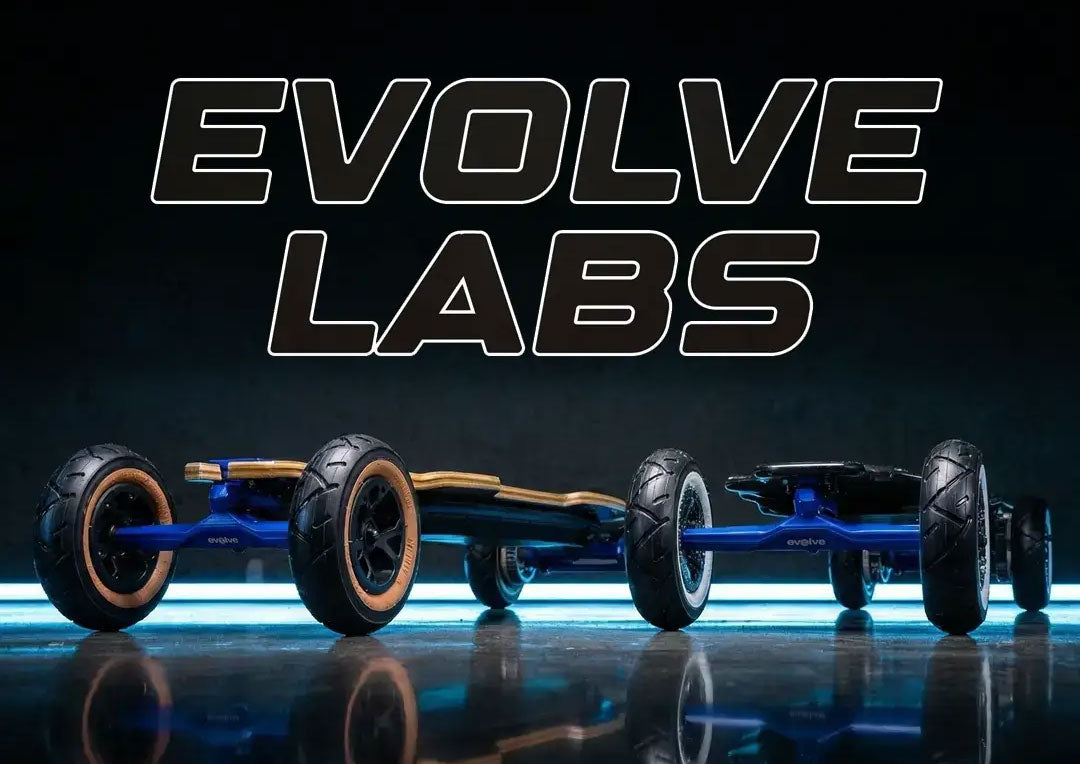
How an electric skateboard belt drive powers the rear wheels

What actually powers the rear wheels on an electric skateboard
Most riders assume an electric skateboard works like an electric bike hub motor, with the motor sitting inside the wheel itself. It is a reasonable guess, but it is wrong, and understanding why changes how you think about performance, maintenance and what you are actually paying for when you buy a premium board.
The front truck does nothing at all
On every Evolve belt-driven board, the front truck carries two wheels that simply roll. There is no motor, no belt, no drive gear anywhere near the front. It exists purely to steer and carve. All the mechanical work, all the power that gets you up a hill in Fremantle or off the line at the lights in Brisbane, happens entirely at the back of the board.
That might sound like a minor detail, but it explains why front wheel wear and rear wheel wear look so different on a well-used board, and why any noise or resistance issue is almost always a rear wheel story, not a front one.
Two motors, two separate drive chains
The rear truck carries two motors, one dedicated to each rear wheel. Each motor drives its own wheel independently through its own belt and gear, rather than one motor splitting power across an axle. This is what allows the board's controller to manage each wheel's power delivery on its own, which matters when you are carving hard and the two rear wheels are travelling at slightly different speeds through the turn.
The actual path power takes from the motor to the ground is worth understanding properly, because it is more layered than most riders expect.
How power actually reaches the wheel
Each motor has a small toothed pulley fixed directly to its shaft. A toothed belt loops around that pulley and around a much larger drive gear mounted on the rear axle, sitting just behind the wheel. The size difference between the small motor pulley and the larger drive gear is doing real mechanical work here, it is what lets the motor spin fast while the wheel turns at a usable speed.
The drive gear itself is not the wheel. It has raised lugs on its outer face, and when the wheel is fitted onto the axle, its hub slides over those lugs and locks into them. That engagement is what makes the wheel spin with the gear rather than around it. A wheel nut on the outside holds the whole assembly together on the axle. Take the nut off and slide the wheel away, and the hub simply disengages from the lugs, leaving the drive gear and belt still sitting on the axle and motor pulley behind it.
It is a genuinely elegant system once you see it laid out: motor, to pulley, to belt, to drive gear, to wheel hub, to wheel. Nothing about it involves the motor sitting inside the wheel, and nothing about it involves the motor shaft touching the ground directly. The belt is the only thing carrying that power across the gap.
Street and all-terrain setups use the same idea, sized differently
If you have ever compared a street wheel setup to an all-terrain setup on the same board, you have probably noticed the rear drive gear looks different between the two. That is deliberate. All-terrain tyres are larger and heavier, so the drive gear fitted for them is bigger than the one used for street wheels. The fundamental layout, motor to pulley to belt to gear to hub, stays the same. Only the sizing of the gear and belt changes to suit the wheel type.
Why belt tension is not a minor detail
Because the belt is the only link between the motor and the wheel, how tight or loose it sits genuinely changes how the board rides. A belt that is too tight adds friction through the whole drivetrain, which can eat into your range and put unnecessary load on the components over time. A belt that is too loose can slip across the teeth of the drive gear under hard braking, and if you have ever heard a sharp clicking noise while braking hard, that is usually exactly what is happening.
Correct tension sits in a narrow, specific window, roughly five millimetres of play in the belt while the wheel still spins freely by hand. It is not something you eyeball once and forget. It is a genuine mechanical relationship that affects braking confidence and how efficiently the board uses its battery.
Where a rigid deck changes what you feel
All of this drivetrain detail matters more the harder you push a board, and that is exactly where deck construction starts to earn its keep. A bamboo deck flexes slightly under load, which is great for a smooth, surf-style ride, but it also absorbs some of the energy travelling from the belt drive to the ground. A carbon deck does not flex at all. Power delivered through the belt and gear translates more directly into forward motion, with less of it lost to the deck itself moving underfoot.
That is precisely the territory the Diablo Carbon Street is built for. Its forged carbon deck gives the drivetrain a completely rigid platform to push against, which is why heavier riders and anyone chasing genuine top-end confidence tend to gravitate towards it. Paired with dual 3500W motors and an 864Wh battery, it holds its power delivery consistently even as speed climbs, rather than feeling like the deck is soaking up part of the effort. If you are commuting through the Gold Coast hinterland or pushing a board hard along Melbourne's bay trails, that rigidity is the difference between feeling connected to the drivetrain and feeling like something is being lost between the motor and the road.
It is worth saying plainly that if you mostly cruise at moderate speed on flat paths around Perth or Sydney's harbourside routes, you will not notice this distinction as sharply. A bamboo deck will serve you well and feels lovely underfoot. But once you are riding hard, carrying more weight, or wanting the drivetrain to feel as direct as possible, the rigidity of the Diablo Carbon Street stops being a nice-to-have and starts being the reason the board feels planted rather than vague at speed.
Understanding the belt drive does not just satisfy curiosity. It explains why tension matters, why your board sounds different under hard braking when something is off, and why the deck underneath that drivetrain is not a cosmetic choice. Once you have felt a rigid carbon platform put that power straight into the road with nothing absorbed along the way, it is hard to go back to anything less direct.
-
Posted in
electric skateboard, evolve
