
 (excl. BMX)
Do electric skateboards work on rough roads?
Do electric skateboards work on rough roads?
Most electric skateboards work fine on smooth asphalt. The question gets more interesting when the road isn't smooth. Cracked footpaths, gravel driveways, tree roots pushing through concrete, fire trails, patchy suburban streets — that's where the difference between boards becomes obvious, and where the right setup changes everything.
The short answer: yes, electric skateboards can handle rough roads, but only if the wheels, deck and motors are built for it. A street board with 97mm urethane wheels will struggle the moment you hit anything beyond light chip seal. An all-terrain board with pneumatic tyres handles the same surface with ease.
Why wheel type matters more than anything else
Street wheels are hard, small and fast. They roll efficiently on sealed surfaces and give you responsive feedback through smooth concrete. But hardness works against you on rough ground. Small stones, raised edges and loose gravel become obstacles rather than terrain.
Pneumatic all-terrain tyres change the physics of the ride. At 175mm in diameter and inflated to around 40 to 45 PSI, they absorb impact rather than transmit it. Roots, gravel and broken edges become part of the ride instead of interruptions to it. The contact patch is larger, grip improves significantly and the board stays planted where urethane would skip.
This is the core reason all-terrain boards exist. It's not just marketing. The tyre does the heavy lifting.
What rough roads actually look like in Australian cities
The definition of rough varies a lot depending on where you ride.
In Brisbane and the Gold Coast, coastal paths can shift from sealed concrete to compacted dirt within a few hundred metres. In Melbourne, older suburbs have footpaths that heave and crack with tree roots. Sydney's hilly terrain means steeper grades combined with worn road surfaces, particularly in inner-west and northern suburbs. In Perth, riders deal with long stretches of good asphalt punctuated by rough transitions and loose gravel near parks. And across regional areas, the road quality drops quickly once you leave the main streets.
If any of those environments sounds familiar, a board that's only rated for smooth terrain is going to limit your riding significantly.
The Renegade Diablo is built specifically for this
If rough terrain is a regular part of your riding, the Renegade Diablo is the board to look at. It's not a street board with an all-terrain option bolted on. It's designed from the ground up for off-road performance.
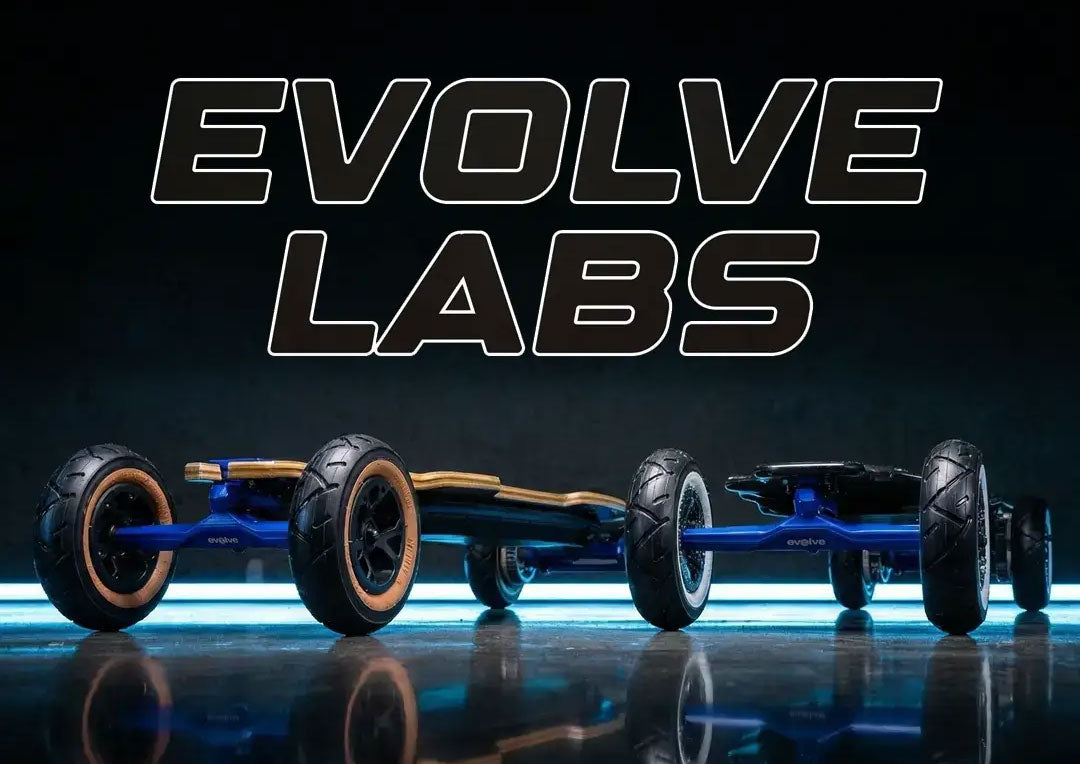
The trucks are wider than any other board in the Evolve lineup, at 39cm across, giving the board a stable, planted feel on uneven ground. The solid carbon deck adds rigidity where bamboo would flex unpredictably over rough surfaces. The 7-inch pneumatic tyres with Evolve hubs soak up the terrain rather than fighting it.
Under the board, dual 3500W motors (7000W combined) push through 45%+ gradients, which matters when rough roads tend to be off the flat paths everyone else sticks to. The 864Wh Samsung battery carries enough capacity for up to 50km of real-world off-road range. Charge time is around four hours with the 5A fast charger included in the box.
It weighs 16.4kg, which is heavier than a street board. That's the trade-off. The mass is part of what keeps it composed on broken ground at speed.
Bindings: optional but worth knowing about
One feature that separates the Renegade from every other board in the range is binding compatibility. On rough terrain, your feet move around more than they would on smooth asphalt. Optional Renegade bindings with toe and heel straps give you a locked-in connection to the board, which is particularly useful on trails, steep descents and loose surfaces. You can run just toe straps if you prefer something less committed.
This is the kind of feature that makes sense once you've ridden challenging terrain. It's closer to snowboard thinking than skateboard thinking, and that's intentional.
When a different board makes more sense
Not every rough road requires the Renegade. If you ride mostly urban paths with occasional rough patches, the Diablo Bamboo All Terrain or Fusion All Terrain cover that middle ground well. Both take 175mm pneumatic tyres and handle mixed terrain confidently.
The Renegade is the right call when your riding is predominantly off-road, when you want binding capability, or when the terrain is genuinely technical. If you're commuting across patchy suburban footpaths, an all-terrain conversion on a Diablo or Fusion is likely enough.
The Renegade is a purpose-built machine. Use it for what it was built for and it's exceptional. Using it purely as a commuter when a Fusion would do the job is a bit like taking a 4WD to the supermarket every day.
Things to keep in mind
- Evolve boards are not waterproof. Newer models including the Renegade have improved sealing, but riding through puddles or wet mud is a risk. Stick to dry conditions wherever possible.
- AT tyres require regular pressure checks. Keep them at 40 to 45 PSI for optimal performance and tyre life.
- Belt drives need periodic inspection, particularly after rough riding sessions where debris can collect around the drivetrain.
- The Renegade's 120kg maximum load rating covers most riders with room for gear.
So, can you ride it on rough roads?
With the right board, yes. Electric skateboards with pneumatic all-terrain tyres handle rough roads well, including gravel, grass, packed dirt and uneven concrete. The Renegade Diablo is the most capable board in the Evolve range for that kind of riding. Wide trucks, rigid carbon deck, binding compatibility and a 7000W dual-motor drivetrain make rough terrain feel manageable rather than something to avoid.
If rough roads are part of your regular riding environment, the board you choose matters. The right setup makes those surfaces part of the experience. The wrong one turns them into a reason to stay home.
See the Renegade Diablo in action:
-
Posted in
electric skateboard, evolve
