
 (excl. BMX)
How powerful are electric skateboard motors?
How powerful are electric skateboard motors?
Most electric skateboards run dual motors producing between 2,000W and 7,000W of combined output, which is far more than most riders expect the first time they twist the throttle. To put that in perspective, a typical electric bicycle motor produces around 250W to 750W. The gap is significant, and it explains why even entry-level e-skate setups can pull up steep hills and reach speeds that demand real focus.
But wattage alone does not tell the full story. How that power is delivered, controlled and tuned determines whether a board feels planted and predictable or just fast and nervous. Understanding what sits underneath the deck helps you choose the right setup and ride it with confidence.
What the numbers actually mean
Motor wattage describes peak output, not constant output. A dual 3,000W setup is rated to produce 3,000W per motor at peak demand, such as launching from a standstill or climbing a steep gradient. During flat cruising, the motors draw a fraction of that.
What matters more in practice is torque delivery and controller quality. A well-tuned motor controller smooths out the power curve so the board accelerates progressively rather than lurching. Evolve uses FOC (field-oriented control) commutation across the current lineup, which allows finer control over motor output at low speeds where torque is highest and the risk of wheel spin is greatest.
The other factor is voltage. Higher voltage systems push more power through the motors with less heat and more efficiency under sustained load. A 12S (50.4V) system like the Diablo and Fusion runs at higher voltage than the GTR's 10S (36V) architecture, which is part of why the flagship boards hold their speed more consistently on longer climbs.
How the GTR Bamboo handles it
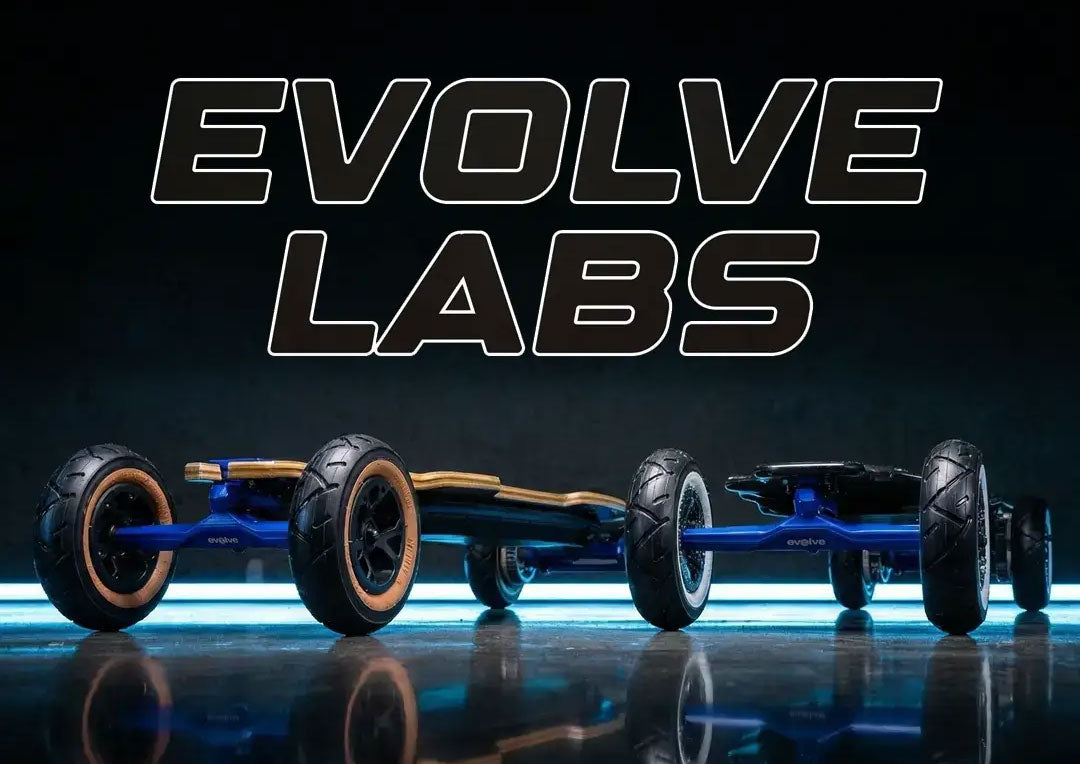
The GTR Bamboo 2-in-1 runs dual 6368 brushless sensored motors producing 3,000W each, 6,000W total. For a board in the entry-level range, that is a serious amount of capability.
It climbs gradients up to 25 per cent, handles real hills at full load and still has enough in reserve to maintain speed when terrain gets demanding. On street wheels it reaches 44 km/h. Swap to the included 175mm pneumatic tyres and the top speed drops to 38 km/h, but grip and terrain versatility increase considerably.
The board ships with three riding modes: ECO, SPORT and GTR. ECO limits acceleration and top speed, making it a sensible starting point for new riders. GTR mode opens the motors up fully. The difference between modes is noticeable, not subtle, and having that range of adjustment built in means the same board suits a cautious first session and a committed carve once your legs know what to expect.
Why dual motors matter
Single-motor boards exist and some perform reasonably well on flat terrain. But dual motors change the character of the ride in a few important ways.
- Power is distributed across two drive wheels, reducing the chance of losing traction on loose or slightly damp surfaces
- Regenerative braking is stronger and more consistent because both motors contribute
- Hill climbing stays controlled rather than dragging or stuttering under load
- The board recovers faster when terrain changes mid-carve
For Australian riding environments, this matters. Sydney's inner suburbs involve constant short climbs between flat stretches. Melbourne bike paths can be smooth for kilometres then cut across cobblestone or worn asphalt without warning. In Brisbane and the Gold Coast, coastal paths often run alongside uneven grass verges where you might drift slightly off line. Dual motors keep the board pulling evenly regardless of minor surface changes.
Perth's flatter terrain is perhaps the most forgiving for single-motor boards, but dual motors still offer better braking feel and more confidence at speed, particularly on the longer sealed stretches along the foreshore.
The role of the motor controller
A motor is only as good as the controller telling it what to do. Evolve's FOC controller reads throttle input and modulates current to each motor in real time. The practical result is that small inputs produce small responses. You do not have to be precise with your thumb to get smooth acceleration. The system handles most of the smoothing for you.
This also affects braking. Regenerative braking on the GTR Bamboo feeds energy back into the battery during deceleration. The harder you brake, the more current the controller manages. Getting that balance right between braking feel and motor stress is what separates boards that last from boards that eat belts and controllers inside twelve months.
The GTR uses belt drive, which is standard across the Evolve range. Belts transmit torque efficiently and are straightforward to replace when they wear. Unlike gear-drive systems, belts also add a small amount of mechanical dampening that reduces the snappy feel that can catch riders off guard during sudden throttle changes.
What 6,000W feels like on the road
For context, 6,000W is roughly equivalent to eight horsepower. On a board that weighs around 12 kg and carries a rider, that power-to-weight ratio produces acceleration that genuinely catches people off guard the first time they push past ECO mode.
The GTR Bamboo's bamboo and fibreglass deck flexes slightly underfoot, which softens the sensation of rapid acceleration compared to a rigid carbon platform. It also absorbs vibration at speed, keeping the ride comfortable over longer distances. The 504Wh battery supports up to 50 km of range on street wheels, which is enough for most commuting loops or recreational sessions without needing to manage charge anxiety through the ride.
In GTR mode on a clear bike path, the throttle response is sharp and the board holds speed well. In ECO mode on a crowded shared path, the same hardware becomes a manageable cruiser. That range of character from one board, driven by the same motors operating at different output levels, is what makes motor wattage less important than motor control.
People also ask
How much power does an electric skateboard need for hills?
For gradients up to 25 per cent, dual 3,000W motors are sufficient for most riders. Steeper terrain or heavier riders benefit from the 3,500W motors found in the Diablo range, which handle 45 per cent gradients. The GTR Bamboo manages most urban hills comfortably at its 25 per cent rating.
Is 6,000W enough for an electric skateboard?
Yes, for the majority of riders and terrain. 6,000W of combined motor output covers hills, fast acceleration and sustained cruising. Boards like the GTR Bamboo 2-in-1 use that output across both motors with a controller that keeps delivery smooth rather than aggressive.
What is the difference between street and all-terrain motors?
The motors themselves are usually the same. What changes is the wheel size and drive gear ratio, which affects torque multiplication and top speed. Larger pneumatic tyres on all-terrain setups roll over obstacles more easily but reduce top speed compared to smaller urethane street wheels.
Can you adjust motor power on an Evolve board?
Yes. The Explore app lets you adjust acceleration curves, braking strength and riding modes. ECO mode significantly limits peak output, SPORT mode sits in the middle and GTR mode gives full access to what the motors can do.
Final answer
If you want a genuine dual-motor setup with real hill capability and the flexibility to ride both street and all-terrain surfaces, the GTR Bamboo 2-in-1 is the most practical starting point in the Evolve range. Six thousand watts of combined motor output, a tunable controller and two complete wheel sets make it a capable and versatile board without requiring you to commit to a flagship price point from the start.
-
Posted in
electric skateboard, evolve
