
 (excl. BMX)
Group riding: how to ride together and actually enjoy it
Group riding on electric skateboards: how to actually enjoy it instead of just surviving it
Most people assume group riding is simple. You find some friends, you charge your boards, you head out. The reality is messier. Group rides fall apart not because the route was wrong or the weather turned, but because nobody talked about pace, spacing or skill level before rolling out. The riders who love group sessions have usually learned this the hard way, often after someone got left behind on a hill or a nervous rider slowed the whole pack to a crawl.
Enjoying a group ride is less about the board underneath you and more about how the group manages the gap between different riders. Get that right and a group session becomes one of the best parts of owning an electric skateboard. Get it wrong and it feels like herding cats down a bike path.
The real problem is rarely the terrain
Groups usually blame the route when a ride goes badly, but the actual issue is almost always a mismatch in riding style or confidence. One rider wants to push sport mode on every straight, another is still finding their balance in eco mode. Put those two on the same ride without a plan and you get frustration on both sides. The faster rider feels held back. The slower rider feels pressured to keep up.
This is where mode selection matters more than most people think. Riding in a shared eco or custom mode for the group, rather than everyone selecting their own, keeps acceleration and top speed consistent across different boards and skill levels. It is a small adjustment that removes a lot of the tension before it starts.
Spacing is a skill, not an accident
Good group riders keep a consistent gap, usually several board lengths, and adjust it based on terrain rather than mood. Tight groups look impressive in photos but they are dangerous in practice, especially when someone brakes hard on a descent or swerves around a pedestrian. A wider, more deliberate spacing gives every rider time to react without panic braking into the person ahead.
Braking behaviour is worth discussing before you leave, not after someone nearly gets clipped. Regenerative braking feels different across boards and riders, and a rider unfamiliar with how firmly a board slows down under load is more likely to overcorrect. Five minutes in a car park before the ride, doing a few stops together, solves this before it becomes a real problem on a descent.
Matching board type to the group's terrain
A group ride only works if everyone's setup suits the actual surface. Mixing street wheels and all-terrain tyres in the same group is fine on sealed paths, but the moment gravel, grass or broken bitumen enters the picture, the street-wheel riders will fall behind or bail out. All-terrain tyres run at 40 to 45 PSI and are built to absorb rougher surfaces, which means the rider on pneumatic tyres will glide over terrain that rattles a rider on hard urethane wheels.
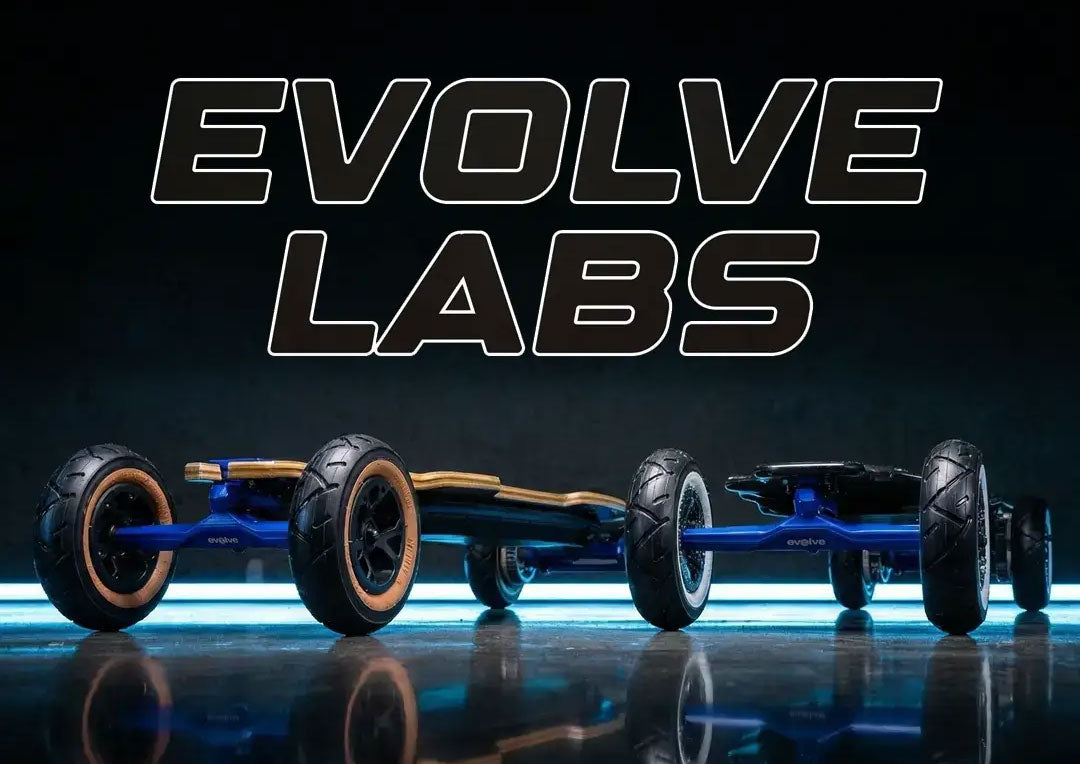
If your group regularly splits between sealed paths and rougher trails, it is worth agreeing on terrain before you leave rather than discovering the mismatch halfway through. Evolve's all-terrain boards handle this kind of mixed riding well, and our bamboo boards in particular give a softer, more forgiving ride that suits riders who are still building confidence at higher speed. Riders on stiffer carbon decks tend to feel more planted at speed but less forgiving over rough ground, so knowing which riders are on which deck type helps the group anticipate who needs to slow down where.
Weight and power differences change the dynamic more than people expect
Heavier riders and lighter riders experience the same board differently, and in a group this shows up as bunching and gapping on hills. A rider closer to a board's maximum load will notice reduced acceleration and slightly shorter range, particularly on inclines above 30 per cent gradient. This is not a fitness issue, it is physics. Groups that understand this stop assuming the slower rider on the hill is doing something wrong and instead build a short regroup point at the top of any significant climb.
This single habit, regrouping after hills or technical sections rather than after the whole route, keeps a group cohesive without slowing anyone down for the flat, easy sections where riders naturally want to open up their speed.
Communication beats hand signals half the time
Hand signals matter, particularly for stopping, turning and hazards, but the more useful habit is verbal communication whenever traffic and wind allow it. Calling out "car back" or "pole" a second earlier than you think you need to gives the rider behind you real reaction time. Groups that ride together often develop their own shorthand over time. New riders should be told what that shorthand means before the ride starts, not mid-descent.
Where Australian cities actually shape the ride
Group riding looks different depending on where you live, and it is worth planning around that rather than against it. Sydney's harbourside paths reward groups who are comfortable with hills and confident braking, given the terrain around the Inner West and northern beaches. Melbourne's flatter bike lane network suits larger groups moving at a steady pace, particularly through the inner suburbs where path width allows side-by-side riding. Brisbane's riverside paths and Gold Coast's long coastal stretches are some of the most forgiving group-riding terrain in the country, wide, mostly flat and well suited to mixed-skill groups. Perth's river paths offer similar conditions, long and open, which makes them ideal for groups still working out their pacing habits.
If you are in south-east Queensland, the Mermaid Waters store is a useful meeting point for local riders heading out along the Gold Coast, and staff there can point newer riders toward routes that suit a first group session.
What actually makes a group ride enjoyable
Enjoyable group rides come down to a handful of decisions made before anyone pushes off: agreeing on pace, matching modes where you can, spacing out properly, and regrouping at the points where the ride naturally splits people up. None of this requires everyone to own the same board or ride at the same level. It requires the group to acknowledge the differences and plan around them instead of pretending they do not exist.
The best group rides I have been part of were not the ones where everyone was equally fast. They were the ones where the faster riders slowed down enough to make it fun for everyone else, and the slower riders pushed themselves just enough to keep up. That balance is not accidental. It is the entire skill of riding together well.
-
Posted in
electric skateboard, evolve
