
 (excl. BMX)
Electric skateboard hill climbing explained
Electric skateboard hill climbing: what actually matters and how to choose the right setup
Hill climbing is where electric skateboards separate themselves. Flat ground performance is easy to market. A steep incline tells you everything about motor quality, battery management and how a board behaves under real load.
If you ride in a city with any elevation, this matters more than top speed. A board that struggles on a 15% gradient is a frustration. One rated for 45%+ is a different tool entirely.
How hill climbing is measured
Gradient is expressed as a percentage, which describes vertical rise over horizontal distance. A 10% gradient rises 10 metres for every 100 metres of travel. Most urban footpaths sit between 5% and 15%. Steeper residential streets push into the 20% to 30% range. Trails and fire roads can go beyond that.
The spec you want to check is the hill gradient rating. It tells you the steepest sustained incline the board can climb under load, at or near the rated rider weight. A board rated for 25% will bog down or cut power on a serious hill. One rated for 45%+ will handle it without drama.
Two things determine climbing performance: motor torque and battery voltage under load. A board with large motors can generate strong torque, but if the battery cannot sustain voltage as current demand spikes, you get throttle cut or reduced power halfway up. Good battery management matters as much as motor size.
Why the Diablo Carbon All Terrain is built for this
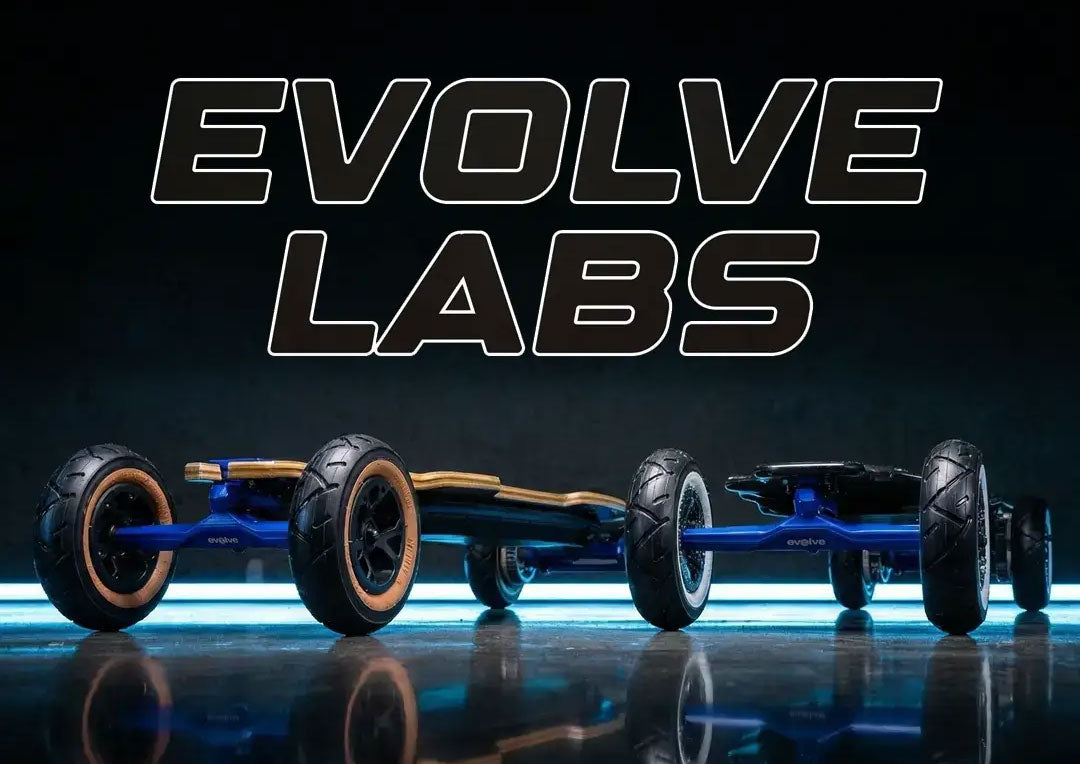
The Diablo Carbon All Terrain is the board to reach for when climbing performance is a genuine requirement. It runs dual 6374 motors producing 3,500W each, 7,000W combined, on a 43.2V system with an 864Wh Samsung 50S battery. The gradient rating is 45% or better.
That combination means the motors have enough torque to pull through steep sections without hesitation, and the battery holds voltage under sustained load rather than dropping off as the climb extends. The EFOC 2.0 controller manages current delivery smoothly, which translates to predictable throttle response on uneven ground rather than jerky power surges.
At 14.35 kg with the 175mm pneumatic tyres fitted, it is not a light board. But that weight reflects the hardware required to actually deliver this level of performance. Lighter boards with smaller motors make compromises at the top of a climb.
What pneumatic tyres do on a hill
Tyre choice changes the climbing experience in ways that are easy to underestimate. Street urethane wheels transmit every crack and bump directly into your legs. On a steep climb, that surface feedback is amplified because your weight is shifted back and your stance is already working harder.
The 175mm pneumatic tyres on the Diablo Carbon All Terrain absorb that surface variation. The grip profile is wider and more forgiving on loose or irregular ground, which gives you confidence to commit through a climb rather than braking mid-hill. On Brisbane's hilly suburban streets or Gold Coast hinterland tracks, that extra grip and compliance makes a genuine difference to how safe and controlled the ascent feels.
Descent is equally important. Braking on a steep downhill requires the same motor power that drives the ascent, now used as regenerative braking. Pneumatic tyres hold their line better when you are braking into a loose surface, and the wider contact patch gives more control in the moments that matter.
Riding uphill in Australian cities
Sydney is the obvious test case. Suburbs like Cremorne, Mosman, and Glebe sit on gradients that would expose any underpowered board within the first few hundred metres. Riders commuting from lower ground to higher neighbourhoods need sustained torque, not just a peak figure.
Melbourne's inner north and east have long stretches of steady incline. Perth's hills district and the approach roads into the ranges push into territory where battery management becomes critical. Brisbane's riverside suburbs shift quickly from flat to steep, sometimes within a single block.
A board rated for 25% might handle individual hills in isolation. When you are stringing them together across a commute, the battery drain accumulates and power delivery softens. The 864Wh battery on the Diablo Carbon All Terrain gives enough capacity to sustain performance across a full session, not just the first climb.
Rider weight and how it changes the equation
Every gradient rating assumes a rider weight. Heavier riders experience steeper effective gradients because the motor load increases proportionally. A board rated for 120 kg and 45% gradient will handle a 90 kg rider on that same gradient with more headroom than the same rider on a board rated for 100 kg maximum load.
The Diablo Carbon All Terrain is rated to 120 kg. For riders above 90 kg, this is the relevant end of the lineup. The rigid forged carbon deck also contributes here. Where a bamboo deck flexes under load, the carbon platform stays consistent, giving heavier riders more predictable feedback through their feet on rough climbs.
What to expect from the EFOC 2.0 controller
Motor controllers are easy to overlook when reading specs, but they govern how power is delivered moment to moment. The EFOC 2.0 controller uses field oriented control commutation, which produces smoother torque curves than older motor drivers. On a steep climb, this means acceleration ramps up without the lurching sensation that comes from less refined systems.
Braking modulation is also improved, which is directly relevant to descents. The ability to feather braking on a 30% downhill, rather than applying it in binary on-off pulses, keeps the ride feeling controlled rather than precarious.
Choosing the right setup for your terrain
If your riding is primarily sealed roads with occasional hills, the Diablo Bamboo or Fusion with street wheels may suit your needs. The all terrain configuration earns its place when your routes include unsealed paths, mixed surfaces or consistent steep gradients where grip and ground clearance matter as much as motor output.
The 2-in-1 version of the Diablo Carbon is worth considering if you want flexibility. It includes both street and all terrain wheel sets, letting you configure the board for the session rather than committing to one setup. Converting between configurations requires basic tools and a full conversion kit.
If you are primarily tackling steep urban streets on sealed surfaces, the street wheel configuration gives faster speed and longer range. If trails, dirt paths or genuinely rough terrain are part of the picture, the all terrain setup is the right starting point.
People also ask
What gradient can the Diablo Carbon All Terrain climb?
It is rated for 45% or greater under load. That covers nearly all urban streets and most off-road trails riders are likely to encounter in regular use.
Does rider weight affect hill climbing performance?
Yes. Heavier riders place more load on the motors and battery. The Diablo Carbon All Terrain is rated to 120 kg, giving most riders a genuine performance buffer rather than operating at the limit of the system.
Are pneumatic tyres better for climbing hills?
On uneven or loose surfaces, yes. The wider grip profile and shock absorption of the 175mm pneumatic tyres provide more confidence on climbs and better braking control on descents. On smooth sealed roads, street wheels offer more efficiency and range.
Can I ride the Diablo Carbon All Terrain in the rain?
Evolve boards are not waterproof. The Diablo series has improved sealing over earlier models, but riding in wet conditions is not recommended and water damage is not covered under warranty.
Where can I see the Diablo Carbon All Terrain in person?
The Evolve store in Mermaid Waters, QLD carries the current lineup. Online orders ship across Australia.
The bottom line: if your rides involve real hills, the motor rating and battery capacity on the board you choose will define your experience more than any other spec. The Diablo Carbon All Terrain is built to handle that load consistently, across varied terrain and at rider weights where other boards start to struggle.
-
Posted in
electric skateboard, evolve
