
 (excl. BMX)
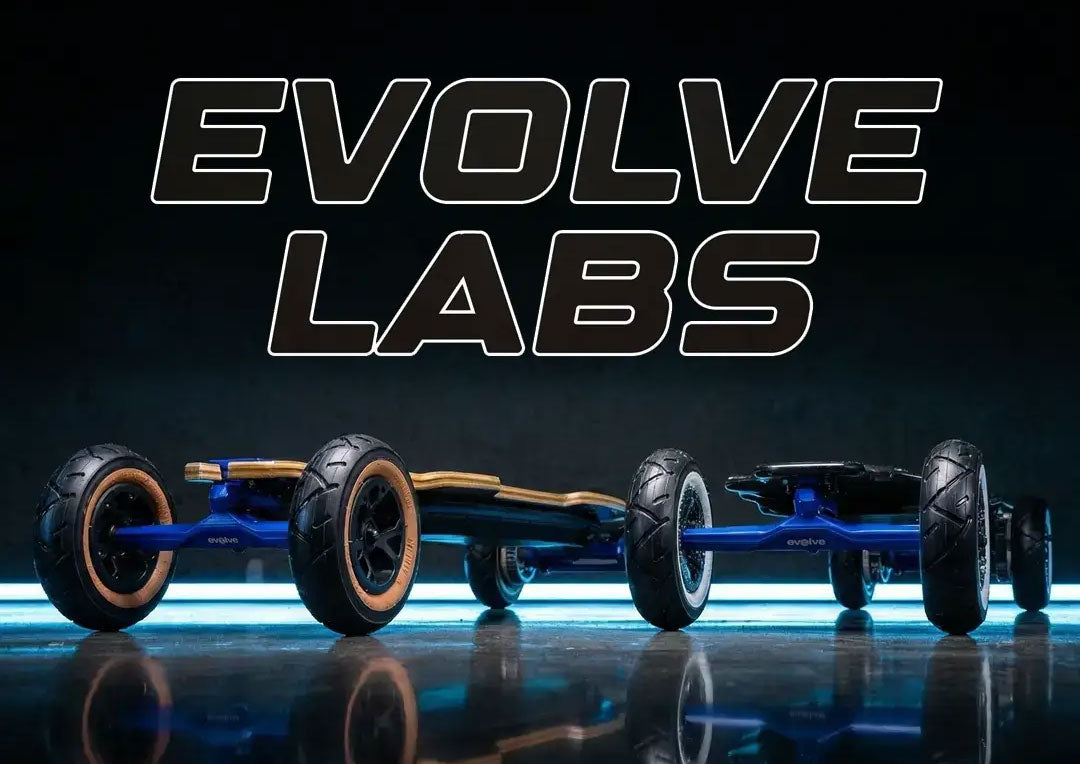
Electric skateboard for camping, caravans and van life
The electric skateboard that actually belongs on a camping trip
Most people think about an electric skateboard the moment they arrive somewhere new and realise the campsite is three kilometres from the nearest town, the beach is further than they want to walk, and the car is inconvenient to move for a quick supply run. The board becomes a tool, not a toy. The question is whether the board you bring is actually built for that reality.
Van life and caravan travel expose gear to things that a daily commuter setup never faces. Corrugated fire trails. Damp mornings. Gravel roads that connect campgrounds to the main road. The mix of sealed and unsealed surfaces that describes almost every destination outside a capital city. A street setup handles none of that well. The wheels are too hard, the ground clearance too low, and the ride too punishing on anything that is not smooth asphalt.
This is where the conversation about all-terrain electric skating actually starts to make sense.
What changes when you are riding away from the city
Urban riding is predictable. Bike paths, footpaths, quiet streets. The surface is consistent, the distances are manageable, and if something goes wrong you are never far from help. Camping and van travel strips all of that away. You are dealing with variable terrain, longer gaps between power sources, and no easy fallback if the board cannot handle what is underfoot.
Range matters differently out here too. You are not worried about making it across the city. You are thinking about whether you can ride to the beach entry, along the foreshore track, back to camp, and still have enough charge to make a supply run the following morning without an opportunity to top up in between. Real-world range on a solid battery becomes a genuine planning consideration rather than a spec you glance at once.
The hill gradient spec matters too, in a different way than it does in Melbourne's inner suburbs or on Sydney's northern side. Campsite access roads, boat ramp approaches, and the rolling terrain around places like the Grampians, the Snowy High Country, or the tracks above Byron all put a different kind of load on the motors than a city commute does. A board that climbs well in the city may labour on a loose gravel incline with a slight headwind.
Why soft tyres change everything on mixed ground
The difference between a pneumatic all-terrain tyre and a standard urethane street wheel is not just about surface compatibility. It is about how the board feels to stand on and how it behaves when conditions change under you.
Soft pneumatic tyres at the right pressure absorb the micro-vibrations and surface irregularities that hard wheels transfer directly to your legs and joints. On a two-hour riding session across mixed ground, that difference accumulates. Riders who have done both will tell you that arriving somewhere not tired from the terrain is a real advantage when you have been on the road for a few days already.
The tyre also gives you grip that urethane cannot match on loose or damp surfaces. Grass between the car park and the beach. Slightly soft ground near a creek crossing. The damp asphalt of a campground road in the early morning. Urethane wheels lose composure quickly in those conditions. A 175mm pneumatic tyre at 40 to 45 PSI holds its line.
The Diablo Bamboo AT is built for exactly this kind of riding
The Diablo Bamboo All Terrain is the board that fits the van life and caravan use case most naturally in the current Evolve lineup. The reasoning is straightforward once you think through what the trip actually demands.
The 864Wh Samsung 50S battery delivers up to 50 km on all-terrain tyres. That is a serious figure for off-road riding. It means a full day of exploring around a campsite, including a run to the nearest town and back, without needing to plan around a charge window. The 4-hour charge time on the included 5A fast charger fits within a relaxed camp morning if you have access to shore power at a caravan park, or a portable power station in a van setup.
The dual 6374 motors produce 3,500W each, 7,000W combined. On a 45 per cent gradient rating, the board handles the kind of steep access road that makes a standard commuter board useless. Loose gravel on an incline, loaded with a slight tailwind or the drag of soft ground, does not phase it.
At 15.3 kg with the all-terrain wheels fitted, it is not the lightest board in the range. But for this use case, that weight is proportional to what it delivers. You are not carrying it through an airport. You are stowing it in a van, a caravan compartment, or the back of a ute. The weight is irrelevant when the board is doing what a car would otherwise do for short trips.
The bamboo deck matters here too. The natural flex in a 3-ply bamboo, 2-ply fibreglass layup gives the board a surf-carve feel underfoot that works well on the kinds of long, sweeping sealed paths you find in coastal towns. The Gold Coast foreshore, the shared paths along Perth's Swan River, the beachside track at Glenelg. When you arrive at somewhere like that after a week on dirt roads and campsite gravel, the bamboo deck rewards you with a ride that feels alive rather than mechanical.
Charging in a van or caravan setup
One practical consideration that does not get much attention: the Diablo's 5A fast charger draws roughly 250W during a charge cycle. That sits within the range of most caravan park powered sites and most van-based solar setups with a decent inverter and battery bank. It is not a power-hungry device.
If you are free camping without shore power, a 1,000W portable power station with solar top-up can realistically handle a full charge overnight or over a slow morning, depending on your solar exposure. For the kind of rider who has already invested in a capable van electrical system, adding a board charge to the rotation is not an additional burden.
The practical cadence that works: plug in when you make camp in the afternoon, ride the following morning on a full battery, charge again when you stop for lunch or set up for the night. Most trips do not require anything more structured than that.
Where this kind of riding actually happens
There are parts of Australia where the Diablo AT makes immediate, obvious sense. The sealed bike paths around Brisbane's bayside suburbs connect campgrounds and foreshore areas that would take 20 minutes to walk but 5 minutes to ride. The long sealed stretches around the Gold Coast hinterland give you genuine speed on a flat, smooth surface before the terrain changes. Sydney's Royal National Park has stretches that are perfect for this kind of board. Perth's coastal paths are some of the best-maintained sealed recreational routes in the country.
But the board earns its keep in the less polished places too. The gravel access roads of a Murray River campsite. The fire trail connection between two campgrounds in the Victorian High Country. The loose stone road down to a boat ramp on a Queensland lake. Those are the moments where a street setup gets left at the van and the AT board gets ridden.
A note on the 2-in-1 option
If your trip covers a mix of genuine city stops and remote camping, the Diablo Bamboo 2-in-1 at $3,049 includes both the 97mm street wheels and the 175mm all-terrain tyres in one box. Swapping between them takes around 20 minutes with the included Y-tool. For a rider doing a lap of the east coast that includes time in Brisbane, the Gold Coast, and remote national park campgrounds, that flexibility is worth the difference in price. But if your travel is predominantly off-grid and the terrains are mixed-surface at best, the dedicated AT setup at $2,899 is the simpler, lighter choice.
The honest assessment is this: if you are spending time outside cities and you want a board that can handle the gap between where you park and where you want to be, the Diablo Bamboo AT does that job better than anything else in the range. It is not a compromise setup. It is built for exactly the kind of riding that camping and van life actually involves.
-
Posted in
electric skateboard, evolve
